



ITA Forklift Forks
ITA forklift forks, also known as clip or hook type forks, are the most common type of forklift fork and the industry standard. They are designed to hang from the forklift carriage using opposing hooks at the top and bottom that engage the carriage fork bars.
Why Choose Us
Quality assurance
Our A strong Quality Management Department ensures that all forks meet highest quality standards.
Reasonable price
Our experienced team focuses daily on supplying you the right product at the right time for the right price.
Customer Service
We prioritize open communication to address our clients' specific requirements and deliver personalized solutions.
Technical Support
Our team of experts is available to assist with troubleshooting, answer technical inquiries, and provide guidance.


People who don't work with forklifts all the time often assume that there is only one type of forks that fit onto lift trucks. There are actually many different types of forks, most of which are interchangeable depending on how you plan to use your forklift.
Fork Types
Forklifts can different types of forks. Here are 11 forklift fork types:
Standard ITA Forks — These are the types of forks most often found on standard forklifts. But even standard forks come in different lengths, widths, depths, and capacities. It's important to know your vehicle's capacity before installing new standard ITA forks onto your mast.
Folding Forks — These forks are hinged so they can fold up to allow the vehicle to maneuver in tight spaces, such as elevators.
Carpet Poles — Single extended poles that are used to lift heavy carpet rolls.
Fork Extensions — Fit onto to standard forks to extend their length for handling longer loads.
Shaft Forks — These are used to suit all pin type carriages.
Lumber and Plywood Forks — Feature a forged heel, square heel, single taper or double taper.
Tire and Barrel Forks — Feature semi-circular cutouts mid-fork to accommodate the lifting of barrels, drums, and tires.
Coil Handling Forks — Feature a contoured blade to lift handle coils. Warning: The capacity may be reduced depending on the size of the contour.
Block Forks — Specially designed to accommodate the safe handling of bricks and construction blocks.
Spark Retardant Forks — Made from non-sparking materials for use in hazardous locations and atmospheres, such as those with combustible gasses of materials.
Non-Current Forks — Forks to fit older vehicles that don't use standard ITA forks.
Pin vs Hook Type Forks
Even standard forklift forks can be separated into two categories: Pin type forks and hook type forks.
Pin type forks fit onto the forklift carriage by use of a pin or shaft, which locks the fork onto the carriage of the forklift. Some pin type forks are telescopic, meaning they can be extended to various lengths and locked into place using the pin.
Hook type forks bend over then lock onto the fork's carriage bar. Both hooks must slip into the end of the carriage bar in order to make a proper fit.
Forklift Blades
There also are various types of forklift blades. For example, there are tapered blades and blunt ended blades. , which offer different levels of protection against puncture of loads from the piercing ends of the forks.
Standard forks are tapered, which accommodates the lead end of the fork more efficiently fitting into the pallet slots. Blunt ended forks are used to provide a higher level of protection against puncture of loads from the piercing ends of the forks, such as when lifting drums or breakable plastic bins.
Some forks are made of specialized materials. For example, stainless steel forks are often used when handling food or chemicals to provide additional protection against cross-contamination.

Forks are required to meet specific industry standards that, essentially, make them interchangeable. However, they are specific to the load capacity of your equipment.
Forklifts
Forklift Forks are most commonly used with the forklift equipment. A forklift is specifically designed for lifting and transporting heavy loads.
Pallet Trucks
Some pallet trucks are equipped with removable or interchangeable forks. This ultimately allows them to be used for different tasks, such as lifting and moving pallets or other heavy materials.
Skid Steer Loaders
In some cases, skid steer loaders can be successfully fitted with fork attachments. This is going to enable them to handle palletized loads.
Wheel Loaders
The wheel loaders that are used in construction and agriculture can sometimes be equipped with fork attachments, in order to handle pallets or other heavy materials.
Telehandlers
A telehandler is a versatile piece of equipment that often has interchangeable attachments – such as a set of forks – for a wide range of material handling applications.
A forklift carriage is the part of a forklift used to mount objects, including the forks, the load backrest, and any forklift attachments. If you have a forklift carriage bumper, it's attached to the carriage as well. The carriage is located between the forklift mast and the forks. It moves along the mast, allowing the forks and load to travel up and down.
International Organization for Standardization (ISO) standards for forklift carriages are laid out by the Industrial Truck Association (ITA). The ITA represents industrial truck manufacturers and suppliers of component parts and accessories in North America, spanning the United States, Canada, and Mexico.
ISO standards allow manufacturers to produce carriages and forks to the same dimensions, so these forklift parts can be used interchangeably on forklift trucks produced by different companies. Standard ISO 2328 specifically governs carriage class measurements.
In this post, we'll go over the different forklift carriage classes, including their dimensions and lifting capacities, and show you how to determine your forklift's carriage class.
Forklift Carriage Classes
Each carriage class is categorized by its carriage height, the measurement between the top edge of your carriage to the bottom. Measuring your forklift's carriage height can help you determine which class it belongs to, which in turn helps you identify your forklift's potential lifting capacity.
ITA Fork Classes
Just like forklift carriages have classes, so do forklift forks. Fork classes correspond with carriage classes.
ITA forklift forks are the most common in the material handling industry, and they're identified by a class number. In order to qualify as an ITA fork, a fork has to meet the criteria outlined in Standard ISO 2328. These forks are also called "clip" or "hook" forks because of how they attach to the forklift carriage.
Forklift arms come in two different types: type A and type B. The difference between the two is determined by their ground-to-carriage distance, measured when the forklift mast is fully lowered. A is the most common type of arm and can be used for indoor and outdoor applications. B arms are mostly used with outdoor lift trucks.
How to Measure Your Forklift Carriage
To find your forklift carriage height, measure the distance between the top and bottom of your carriage bars. Then refer to the carriage classification chart above to help determine your forklift's carriage class.
While the carriage class gives you some idea of what your forklift can do, it's always good to check your machine's data plate for its exact capabilities and limitations. The data plate and exact specifications are the most reliable determiners to use when you're looking for the right vehicle for a job.
What Parts Are Connected to the Forklift Carriage?
The fork carriage is a foundational forklift part, a necessary support structure for the machine's function. Without its support, a forklift couldn't lift. Here's how it connects to some of the other main parts of a forklift:
Forks: The forks on a forklift may be controlled by the mast, but the carriage is what attaches them to the vehicle and makes them stable for use.
Load backrest: The load backrest attaches to the sides of a forklift carriage. It's a stabilizing component, preventing the forklift's load from falling back toward the operator.
Mast: A forklift carriage acts as a connecting part between the mast and forks. By supporting the mast, the carriage helps keep it stable as loads move up and down the mast channel.
How Much Can a Forklift Carriage Lift?
The exact lifting capacity of a forklift depends on the model, but most forklifts can haul up to almost 25,000 lb. Generally, the lifting capacity corresponds to the carriage size. If you need a forklift with a high lifting capacity, choose one with a larger carriage.
It's also important to note the lifting capacity of the forks, which may be different than the carriage lifting capacity. Use the lowest lifting capacity of the two to inform your load.
5 Points of Concern When Choosing Lift Truck Forks
Selecting the correct fork helps to prevent damage to your goods, lift truck and infrastructure. How exactly do you choose the right fork? Below we will guide you through the 5 major questions you should ask yourself.
What is the capacity of your lift truck?
What type of lift truck forks you need, will depend on the capacity of the lift truck. If this capacity is 2 tonnes, then you also need forks that can lift 2 tonnes. The fork section determines how much a lift truck fork can carry. This is the thickness and the width of the forks. The larger the fork section, the more weight the forks can carry.
What type of fork do you need?
The fork carriage determines what type of fork you can mount on it. Heavier machines usually use PIN forks, but there are also other types:
FEM
DIN
Terminal West
SVGV forks
Bolt-on forks
How high is the fork carriage of your lift truck?
The height of the fork carriage also determines what lift truck fork you should choose. This especially applies to FEM and DIN forks. Standard FEM forks exist in 5 different carriage heights, and each carriage height also exists in 2 different ground clearances. This is the difference from the inside of the bottom fork hook to the ground. For non-standard FEM and DIN forks you always need to take into account the dimensions of the carriage and the ground clearance.
What length do the forks need to have?
The length of the forks depends on the dimensions of the goods you transport.
The goods or pallets always need to be supported fully by the forks. E.g. do you mainly transport EUR-pallets? Then you forks will need to be at least 1200 mm long.
Do you have any other specific requirements?
In certain industries, it is necessary to equip your lift trucks forks extra.
● An antiskid coating
Do you often work with oils or in damp environments? In that case, select a fork with an antiskid coating. You can also install a scratch-resistant, antiskid rubber fork protector onto your existing forks.
● Built-in scales
Do you wish to weigh your goods immediately after lifting them? Then opt for forks with built-in scales.
● Shock-absorbing pads
Do you handle fragile goods? Use shock-absorbing pads on your forks.
● Telescopic forks
Would you like to load two pallets simultaneously or stock a pallet at double depth without having to switch forks? In that case, telescopic forks are the way to go.
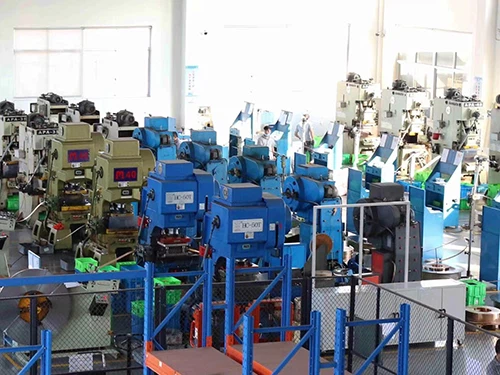
Our Factory
JOYEAR manufactures direct replacement forks for all the main forklift turck brands. Our daily motivation and passion is the development of advanced solutions to improve your safety, precision and efficiency. Working together with you, we are constantly working on new solutions that make JOYEAR forks even better and perfect for the application. As a leading manufacturer, we have the ability to manufacture forks individually with regard to form, design and quantity to ensure that you remain flexible and are always one crucial step ahead of the competition. The JOYEAR solutions meet the highest demands on manufacturing quality, reliability and longevity. Always with an eye towards safety during everyday operations.
FAQ