


Shaft Mounted Forks
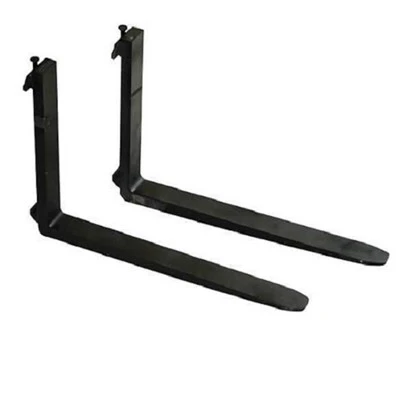
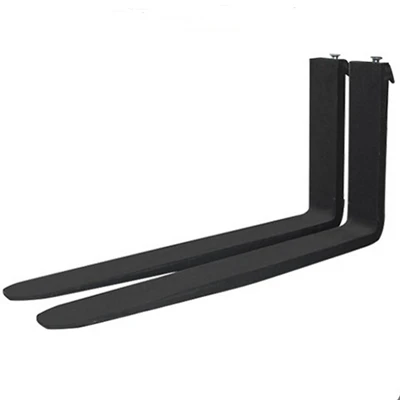
Shaft mounted forks, which are also known as pin-type forks, are commonly used on telehandlers, wheel loaders and forklifts that have over a 15,000 pound capacity. Instead of mounting on flat notched steel, these forks are mounted on a shaft that spans along the width of the carriage.
Why Choose Us
Quality assurance
Our A strong Quality Management Department ensures that all forks meet highest quality standards.
Reasonable price
Our experienced team focuses daily on supplying you the right product at the right time for the right price.
Customer Service
We prioritize open communication to address our clients' specific requirements and deliver personalized solutions.
Technical Support
Our team of experts is available to assist with troubleshooting, answer technical inquiries, and provide guidance.




Enhanced Reliability, Stability & Safety
One of the key advantages of Shaft Mounted Forks is the superior stability.
The shaft and pin are going to provide a secure connection, making sure that the forks remain securely attached to your equipment when moving a heavy load. This stability and reliability of the fork attachment will, essentially, minimize the risk of the load shifting or tipping. With that being said, these forks promote a safer work environment for operators and can, additionally, help to prevent potential accidents.
Quick & Easy Attachment & Detachment
The design of shaft mount forks will enable a quick and effortless attachment process, as well as a fast detachment.
To accurately hold the forks in place, the shaft is simply inserted into the carriage, so that the pin can be placed to directly secure the forks. This quick and straightforward process is going to allow efficient swapping of forks, particularly when different load sizes are necessary or scenarios require different abilities. Operators will be able to save valuable time during loading and unloading operations. Thus, increasing your productivity overall.
Versatility For Varied Applications
Shaft mounted forks are going to provide versatility, specifically in terms of fork length and configuration.
When you are using pin type forks, different lengths of forks can be easily interchanged on your equipment. This will enable you to successfully handle a variety of load sizes and types. Whether you are needing to transport pallets, barrels or other specialized loads, shaft mount forks have the ability to properly adapt to any environment and accurately meet specific material handling requirements. This adaptability is what makes them such a valuable tool across a wide range of industries – such as warehousing, construction and manufacturing.
Compatibility & Availability
Has several fork options available. For instance, we offer different fork widths and materials to suit specific applications and environments.
Our facility has an extensive library fork specifications for many makes and models of equipment today.
Understanding Forklift Fork Types
Forklift Fork Classifications and Dimensions
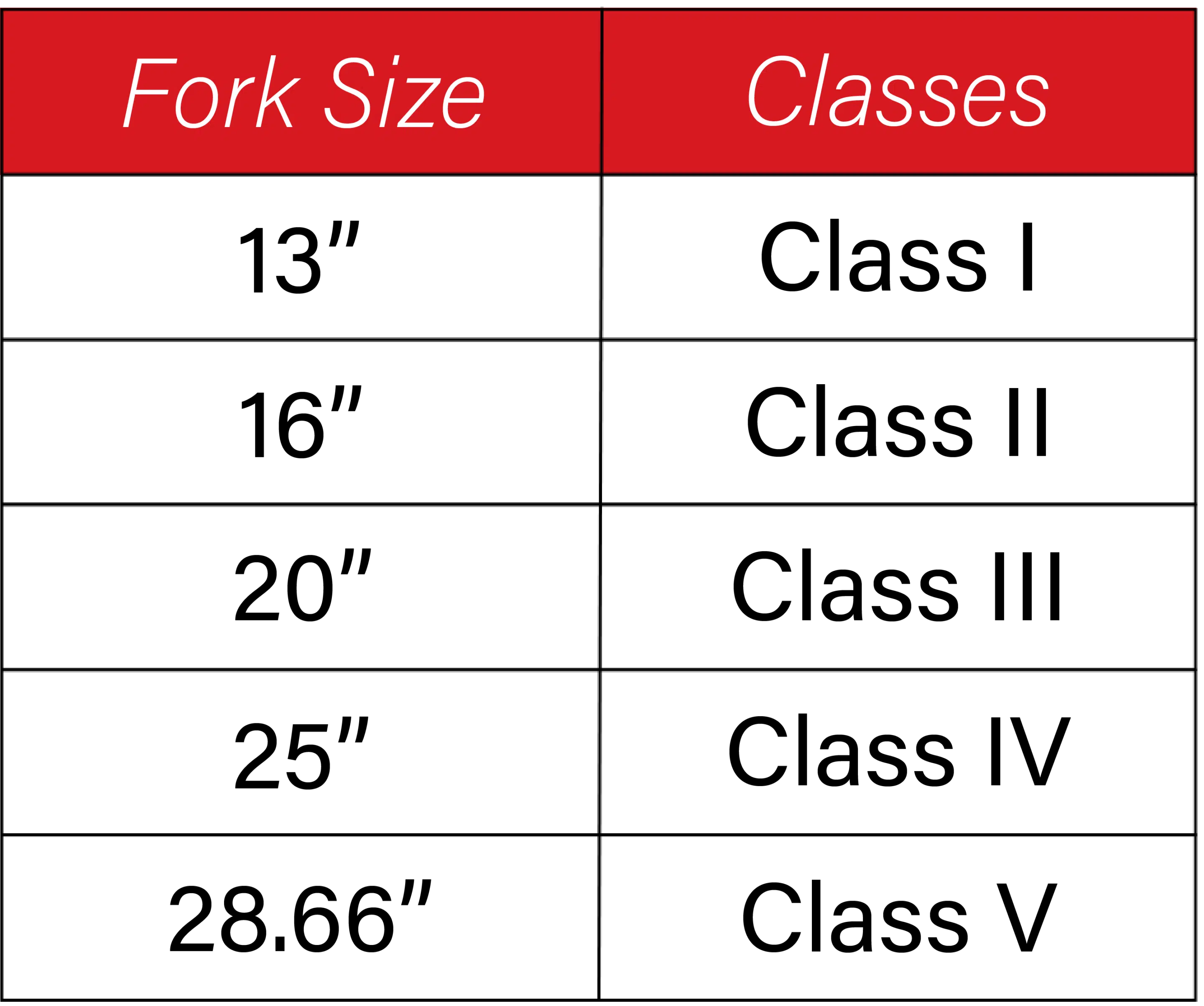
Forklift forks are categorized into International Transport Association (ITA) classes based on the distance between the bottom of the carriage fork bar and the top bar where the fork hooks mount. There are five main ITA forklift carriage classes, each designed to support different weight capacities and applications. For instance, Class 2 forks are suitable for loads up to 5,500 lbs, while Class 5 forks can handle weights over 18,000 lbs. Common dimensions used to describe forklift forks include thickness (T), width (W), and length (L), with typical sizes being 1 1/2" x 4" x 42". These dimensions are crucial for ensuring the right fit and functionality for specific tasks.
Material and Build Quality
The durability and performance of forklift forks are significantly influenced by their material and construction. High-strength alloy steel is commonly used for manufacturing these forks, which undergoes a heat treatment process to enhance their toughness and hardness. This treatment ensures that the forks can withstand the rigors of heavy lifting and frequent use without compromising safety or efficiency.
Specialized Fork Types and Their Uses
Forklift forks come in various styles to accommodate different materials and handling requirements. For example, Shaft Mount or Pin Mount Style Forks are typically used in older or larger forklifts and are custom-built to suit specific needs. Specialty forks such as Block Handling Forks, Drum Handling Forks, and Coil Handling Forks are designed for specific types of cargo. These specialized forks ensure that materials such as bricks, drums, or coils are transported safely and efficiently, minimizing the risk of damage during handling. Additionally, Fork Extensions can be used to temporarily extend the reach of standard forks, although they are not recommended for prolonged use due to safety considerations.
Each type of fork is tailored to meet particular operational demands, making it essential to select the right fork type based on the specific requirements of the task at hand.

One of the important questions facing anyone who owns a forklift is what type of replacement fork you should buy. The fork, also known as the blade, is obviously one of the most important parts of the forklift—after all, it is used to lift loads and support pallets, among other purposes—but if you do not change your forks you really shouldn't be surprised when your performance suffers.
There are two main types of replacement forks: the most common is the hook style, and the other popular one is the shaft, or pin model. The hook style model bends over and fits into the end of the carriage bars, locking into the end of carriage bars. Forklift operators who lift loads that are not especially heavy are well-served to spring for the hook style replacement fork.
Meanwhile, for more extreme loads, the shaft model is the better option. Shaft forks can lift upwards of 12000 pounds of gross capacity. They are also more adjustable, making them a superior option for those who lift a wide variety of pallet sizes. Operators who routinely have difficulty keeping the load in a precise position are also advised to select the shaft model.
Before making your decision on a replacement fork, check with your Forklift Accessories professional to get their educated opinion. Another thing you should bear in mind is that it is always a good idea to purchase a backup set of replacement forks, and you may also want to carry replacement forks that have a different length, so that you can rest assured that you have the right equipment for the job.
Finally, here are a couple of handy tips to ensure that you get the most out of your forks. First, you should only raise your forklift as high as needed. It is also important to make sure that the forklift is not operated at a fast speed—only drive at a speed that is easily "stoppable," in the event that an accident were to take place. In the end, if you operate your forklift responsibly and replace the fork at regular intervals, you should be able to get a decade of use (or more) out of your forklift.
Shaft mounted forks are integral components for material handling tasks, designed to be mounted on the machinery's carriage via shafts. Their design and compatibility are critical for safe and efficient load handling.
Design and Types
Shaft mounted forks are typically forged from high-grade steel to ensure durability and strength. There are different types of shaft mount configurations to cater to varying load requirements and applications.
Pin-type forks are common, which secure to the carriage using a pin across the width, enhancing stability.
Safety and Standards
Adherence to safety standards like ISO 3834-2 is non-negotiable for ensuring operator well-being and overall workplace safety.
Every fork must meet these international standards for welding quality, which reflects on the reliability and load bearing capacity of the forks.
Operational Considerations
Operators should know the exact measurements and weight limits of their shaft mounted forks to prevent mishandling of pallets or loads.
The forks should be inspected regularly for signs of wear or damage to preserve integrity during extreme working conditions.
Industry Applications
Shaft mounted forks are used in diverse sectors, including logistics, construction, and agriculture. The various applications emphasize the importance of proper forks selection based on the specific requirements of the production and load to be moved.
Choosing the Right Forks For Your Forklift
What class of forks do I need for my forklift?
When it comes to operating a forklift efficiently and safely, having the right type of forks is crucial. Forklifts are versatile machines used in various industries to lift and transport heavy loads, and the type of forks you choose can significantly impact the performance and productivity of your forklift.
Understand Your Material Handling Needs
Forklifts are categorized into classes according to different factors such as fuel type and purpose. Fork designs need to adhere to industry norms for interchangeability, regardless of the lift truck maker. However, they are tailored to match the lifting capacity of each individual forklift. The first step in choosing the right lift truck forks is to assess your material handling needs. Consider factors such as the types of loads you handle, the weight and dimensions of the loads, the environment in which the forklift operates, and any specialized requirements unique to your industry. Understanding these needs will help you determine the right length, width, and capacity of the forks required to efficiently handle your materials.
Fork Size and Capacity
Forklifts come in various sizes and configurations, and the fork size and capacity need to match the specifications of the forklift model. Properly sized forks ensure that the load is centered and distributed evenly, preventing tilting or tipping. Forks with inadequate width may result in load slippage, while forks that are too wide might interfere with nearby objects or cause difficulty maneuvering in confined spaces. The length of the forks should be sufficient to support the full length of the load and extend beyond it by at least six inches. Overloading the forklift with loads exceeding its rated capacity can lead to accidents, equipment damage, and injuries to operators and bystanders. On the other hand, using forks with a lower capacity than required may lead to premature wear and failure of the forks under heavy loads. Adhering to the recommended capacity ensures the forklift can handle loads safely and effectively.
Fork Material and Construction
Investing in high-quality forks made from the right materials and constructed with precision will not only ensure the forklift's optimal performance but also promote a safe and productive material handling environment. There are variations in fork construction, such as standard, forged, and coated forks. Forged forks are more robust and have a higher load-bearing capacity, making them suitable for heavy-duty applications. Coated forks offer better protection against rust and corrosion, making them ideal for outdoor or damp environments. Choose the fork material and construction that aligns with your specific operational conditions and budget.
Safety Features
Safety should be a top priority when selecting lift truck forks. Look for features like heel wear indicators, which provide a visual cue to monitor the wear on the forks' heels. This helps identify when it's time for replacement to prevent failure during operation. Additionally, some forks come with safety lock mechanisms to secure them to the forklift carriage, reducing the risk of accidental detachment while lifting loads.
Consider Fork Attachments
Certain applications may require specialized fork attachments to enhance productivity and versatility. Popular attachments include fork positioners, sideshifters, and extensions. Fork positioners allow the operator to adjust the fork spacing without leaving the cab, while sideshifters enable lateral movement for precise load positioning. Fork extensions are useful for handling longer loads that exceed the length of standard forks. Evaluate your operational needs to determine if any of these attachments would be beneficial for your lift truck.
The Key to Calculating What Size Forks You Need:
The way to determine which class of forks you need is to measure how tall your carriage is. The carriage is located on the front of your forklift that the forks connect to.
Our Factory
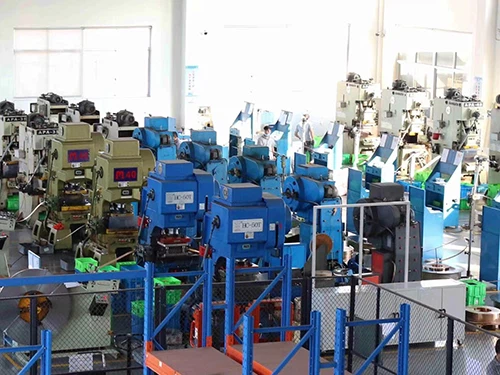
JOYEAR manufactures direct replacement forks for all the main forklift turck brands. Our daily motivation and passion is the development of advanced solutions to improve your safety, precision and efficiency. Working together with you, we are constantly working on new solutions that make JOYEAR forks even better and perfect for the application. As a leading manufacturer, we have the ability to manufacture forks individually with regard to form, design and quantity to ensure that you remain flexible and are always one crucial step ahead of the competition. The JOYEAR solutions meet the highest demands on manufacturing quality, reliability and longevity. Always with an eye towards safety during everyday operations.
FAQ