



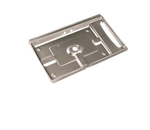


High-Speed Progressive Die Stamping
Among the steel products in the world, 60-70% are plates, most of which are stamped into finished products. There are a large number of stamping parts in the car body, chassis, fuel tank, radiator, container shell, instrumentation, household appliances, bicycles, office machinery, living utensils and other products.
Compared with castings and forgings, stamping parts have the characteristics of thinness, uniformity, lightness and strength. Stamping can produce workpieces with ribs, ribs, undulations or flanges that are difficult to manufacture by other methods to increase their rigidity. Due to the use of precision molds, the precision of the workpiece can reach the micron level, and the repeatability is high, and the specifications are consistent, and holes, bosses, etc. can be punched out.
Stampings generally do not undergo additional machining, or require only a small amount of machining. Stamping is an efficient production method. Using composite dies, especially multi-station progressive dies, can complete multiple stamping processes on one press, realizing the full process from strip uncoiling, leveling, punching to forming and finishing. automatic production. The production efficiency is high, the working conditions are good, the production cost is low, and the progressive die can even produce hundreds of pieces per minute.
The raw materials of stamping parts are also very wide, the most common are steel, stainless steel, aluminum, copper, brass and so on. They can be treated with various surface treatments to achieve anti-rust and aesthetic effects. Such as galvanizing, powder coating, painting, nickel plating, anodizing, etc.
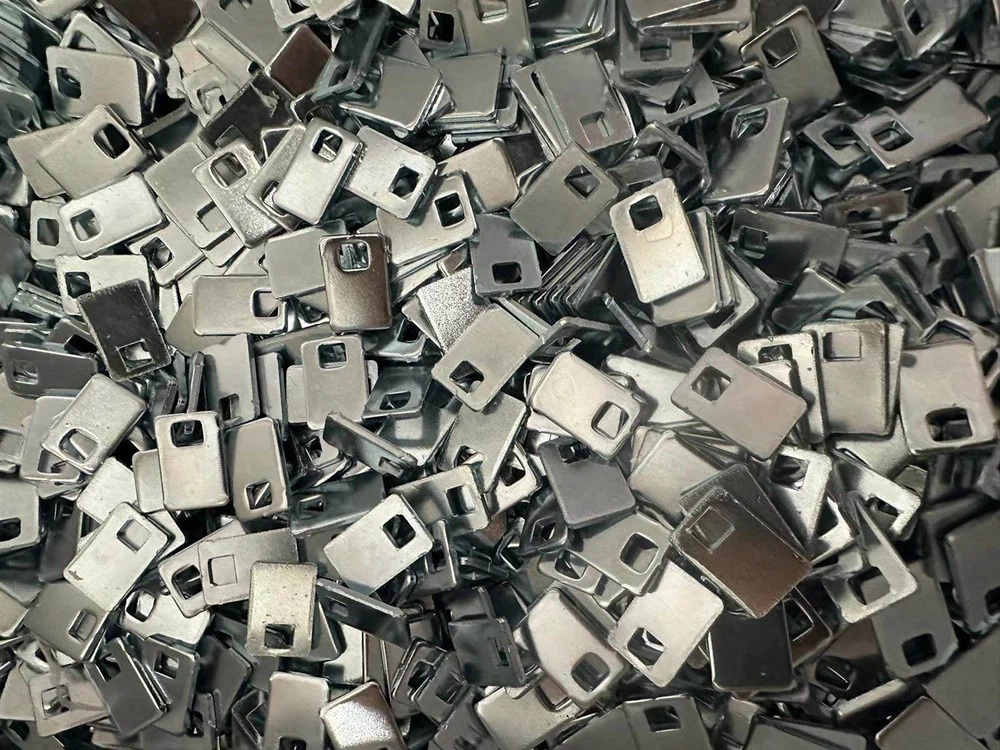
Drawing Design & Confirm
Get drawings from customers, or design drawings according to customers' detail requests or sample.
The two parties confirm the details of the drawings and product raw materials, surface treatment, etc.

Price & Order
Quote and confirm order quantity, specify all the details including trade terms, payment terms, type of package, etc.

Tooling Design & Manufacturing
Design and Make tooling according to the confirmed drawing, do the modification if needed while testing.

Sample Approval
Make first samples and inspect them according to the drawing strictly.
Send to the customer for approval after internal approval.

Production & Shipping
Strictly produce the goods as per the drawings and first samples.
Packed well after final inspection and ship to customers.


Introduction
High-Speed Progressive Die Stamping revolutionizes mass production of precision metal components by synchronizing multi-stage forming operations within a single press cycle, achieving throughput rates exceeding 1,200 strokes per minute. This method excels in fabricating intricate geometries-such as micro-electronic connectors with ±5-micron dimensional tolerances or automotive fuel injector plates requiring burr-free edges-through meticulously engineered die sets. A 2024 benchmark analysis by the Journal of Manufacturing Systems demonstrated that progressive die stamping reduces unit costs by 18-22% compared to transfer stamping for high-volume runs, primarily through minimized material handling and nested blanking layouts that achieve 93-96% sheet utilization.High-Speed Progressive Die Stamping revolutionizes mass production of precision metal components by synchronizing multi-stage forming operations within a single press cycle, achieving throughput rates exceeding 1,200 strokes per minute. This method excels in fabricating intricate geometries-such as micro-electronic connectors with ±5-micron dimensional tolerances or automotive fuel injector plates requiring burr-free edges-through meticulously engineered die sets. A 2024 benchmark analysis by the Journal of Manufacturing Systems demonstrated that progressive die stamping reduces unit costs by 18-22% compared to transfer stamping for high-volume runs, primarily through minimized material handling and nested blanking layouts that achieve 93-96% sheet utilization.
Future Development
The high-speed progressive technology's Achilles' heel lies in dynamic tool wear, particularly during ultra-thin gauge stamping. While carbide inserts coated with nanocomposite TiAlN layers extend die life by 300%, their brittleness risks edge chipping during rapid cyclic loading-a paradox mitigated through AI-driven predictive maintenance. For instance, vibration signature analysis algorithms now detect early-stage die misalignment at 0.03mm thresholds, triggering self-adjusting shim systems that maintain press parallelism without human intervention. Such innovations counterbalance historical criticisms of progressive stamping's inflexibility in short-run production.
Emerging applications in flexible electronics assembly highlight the process's adaptability. Conductive trace stamping on polyimide films now achieves 50µm line widths using progressive dies with diamond-coated punches, though thermal expansion mismatches between tooling and substrates limit yields to 82-85%. Collaborative robotics address this-vision-guided delta robots perform in-die micro-adjustments during the 0.5-second press cycle, compensating for film creep with 0.01° angular precision. Such symbiosis between mechanical engineering and AI positions high-speed progressive die stamping not merely as a manufacturing workhorse, but as a catalyst for cross-industry technological convergence.
Applications
In automotive electrification applications, the process faces unique challenges: laminar stack stamping for EV motor cores demands anisotropic grain alignment conflicting with high-speed shear requirements. Hybrid solutions employing servo-driven variable blank holders now modulate clamping forces dynamically, enabling 40% faster production of silicon steel laminations while reducing magnetic flux losses by 15%. However, this introduces harmonic oscillations in press frames, necessitating real-time finite element analysis (FEA)-guided counterweight adjustments-an integration still requiring 12-18% longer setup times versus conventional systems.
Although coil-to-component stamping eliminates 85% of machining waste, the energy intensity of precision grinding for die maintenance (averaging 8-10 kWh per tonnage hour) offsets 30% of carbon savings. Pioneering closed-loop lubricant recovery systems, as adopted by a European auto consortium, reclaim 78% of cutting fluids while filtering sub-15µm particulate matter, aligning with ISO 14044 lifecycle standards. Yet, the residual 22% chemical waste remains a pain point, spurring research into laser-textured self-lubricating die surfaces that reduce fluid dependency by 60% in prototype trials.
Hot Tags: high-speed progressive die stamping, China high-speed progressive die stamping manufacturers, suppliers, factory, Other Metal Parts, Automotive Metal Stamping Parts, Stamping Hardware, Sheet Metal Stamping Parts, Steel Copper Aluminum Stamping Parts, Precision Stamping Parts
You Might Also Like


Send Inquiry