



125x45 Blank Forks
MOQ : ≥ 20 pieces
Sample Delivery : 3–7 days
Available Fork Length : 1,000–2,400 mm
Capacity of fork couple: 4200kg
Load center : 500mm
Mounting class :3A
125×45 blank forks are not optimized for speed in light-duty applications. Instead, priority is given to sectional moment of inertia and root bending resistance, providing sufficient mechanical reserve for subsequent sleeve welding, bend forming, or attachment integration. This is the core value of the blank design: it serves as a base component with consistent section accuracy and uniform material quality, rather than a finished fork ready for direct mounting on lift trucks. For manufacturers integrating forks with custom clamps, extensions, or non-standard hooks, the 125×45 cross-section provides a standardized mechanical baseline, so downstream modifications do not require re-verifying the section's load-bearing logic from scratch.
The engineering value of blank forks lies in process continuity from raw stock to finished part, not in dimensional figures alone. Blanks produced by closed-die forging or controlled rolling and cooling exhibit uninterrupted grain flow along the fork profile, preventing disruption of the fiber structure that cutting or localized heating would cause. Multi-heat forging with controlled cooling reduces unilateral machining allowance to the millimeter range while refining grains and effectively minimizing internal porosity and segregation. For fatigue validation, finished forks conforming to ISO 2328 exhibit minimal residual deflection at the fork tips after more than 100,000 load cycles under continuous three-shift operation.
Before placing an order, buyers should distinguish between three sets of requirements:
Dimensional requirements
- These define the blank itself, including its nominal width, thickness, overall length, and any additional dimensional tolerances specified in the drawing.
Manufacturing requirements
- These identify the operations required after delivery, such as machining, profiling, forming, or the preparation of a mounting interface. The actual operations depend on the intended design.
Finished-component requirements
- These concern the completed fork, including its interface with the carrier, inspection criteria, and applicable load-rating requirements.

Keeping these requirements separate helps purchasing teams avoid paying for unnecessary processing or receiving a component that does not fit their production plan.
Specifications

| Specification | Metric | Imperial |
|---|---|---|
| Capacity of Fork Couple | 4,200 kg | 9,259 lb |
| Load Center | 500 mm | 19.69 in |
| Mounting Class | Class 3A | Class 3A |
| Fork Section | 125 × 45 mm | 4.92 × 1.77 in |
Available Fork Lengths and Individual Fork Weights
| Fork Length (mm) | Fork Length (in) | Weight of Single Fork (kg) | Weight of Single Fork (lb) |
|---|---|---|---|
| 1,000 | 39.37 | 64 | 141.1 |
| 1,100 | 43.31 | 69 | 152.1 |
| 1,200 | 47.24 | 72 | 158.7 |
| 1,300 | 51.18 | 76 | 167.6 |
| 1,400 | 55.12 | 80 | 176.4 |
| 1,500 | 59.06 | 85 | 187.4 |
| 1,600 | 62.99 | 89 | 196.2 |
| 1,700 | 66.93 | 93 | 205.0 |
| 1,800 | 70.87 | 96 | 211.6 |
| 1,900 | 74.80 | 100 | 220.5 |
| 2,000 | 78.74 | 104 | 229.3 |
| 2,100 | 82.68 | 109 | 240.3 |
| 2,200 | 86.61 | 113 | 249.1 |
| 2,300 | 90.55 | 118 | 260.1 |
| 2,400 | 94.49 | 122 | 269.0 |
product performance
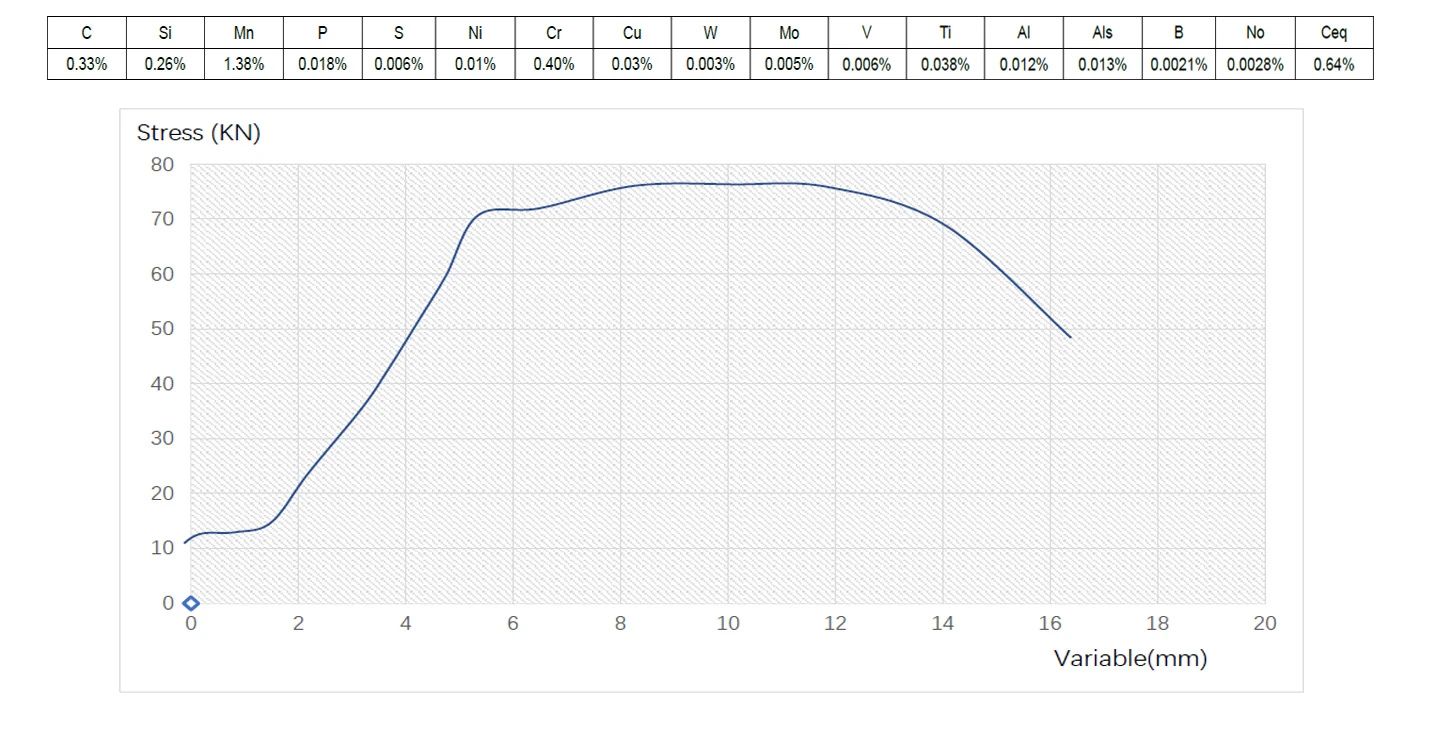
production flow chart

quality control

Loading Test

Hardness Test
applications
JOYEAR's 125x45 blank fork solutions are engineered for efficiency and reliability based on real working conditions. The four application scenarios below illustrate how different fork designs target material handling bottlenecks and unlock on-site productivity.

Dock Loading Throughput Improvement
The bottleneck at logistics yard loading docks rarely lies in forklift lifting speed; it lies in alignment pauses and height gaps as forks enter and exit containers. Once the dock leveler is flush with the container floor, forklift forks can travel continuously through the loading cycle. Single-truck handling time is reduced by 60%, and the yard can handle 30% more delivery trucks per day. Conventionally, forks require repeated height and angle adjustments at container edges, disrupting workflow continuity. The flush surface converts intermittent handling into continuous material flow.
Synchronous Lifting for High-Bay Picking
In conventional high-bay warehouses, stacking and picking are separate operations. After a forklift delivers pallets to high rack positions, pickers rely on additional equipment to access goods, causing non-value-added waiting time. On man-up three-way forklifts, the forks and operator cabin lift synchronously during travel. Operators reach target rack levels directly to place pallets and pick loose goods in one sequence. According to Zoyi Intelligent Forklift data, this configuration increases storage capacity by 50%, and the three-way fork completes a 180° rotation within 10 seconds. The fork function extends the picking flow and eliminates non-value-added movement between processes.


Telescopic Forks for Cross-Docking
At high-volume distribution centers processing tens of thousands of pallets daily, standard forks require frequent fork-length changes for non-standard pallets, interrupting operations. Hydraulic telescopic forks adjust fork length on a single forklift and handle multiple pallets simultaneously. Field tests by Meijer Handling Solutions at the Veenstra|Fritom cross-docking facility show a 37% improvement in loading efficiency and approximately 20% faster unloading. This eliminates the repeated cycle of fork retrieval, replacement and refitting, enabling pre-sorted pallet batches to be consolidated for loading.
Dual Forks for Container Yards
At export consolidation yards, single-pallet handling forklifts follow a "one pallet out, empty return" cycle, with empty travel accounting for nearly half of total cycle time. Paired front and rear forks operate in tandem: while the front fork set unloads, the rear set is positioned ready to pick. This eliminates empty return runs. Material handling technical documentation indicates that dual-fork designs increase throughput by more than 100% compared with single-pallet back-and-forth workflows. Each cycle handles two pallets instead of one without increasing travel distance.

packing & Delivery
To better ensure the safety of your goods, professional, environmentally friendly, convenient packaging services will be provided.


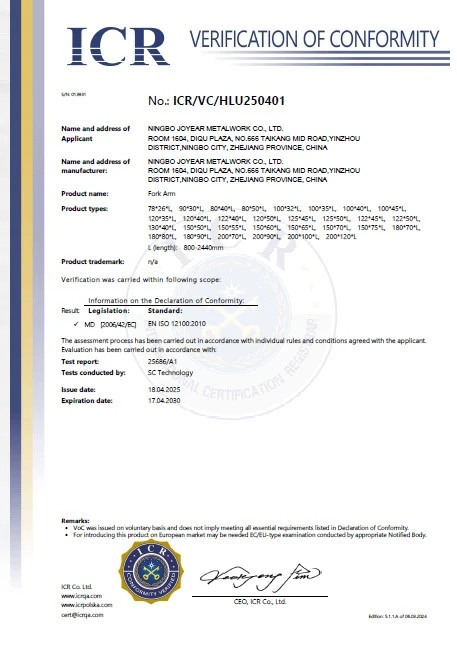
Certification


Hot Tags: 125x45 Blank Forks, China 125x45 Blank Forks manufacturers, suppliers, factory, Blank Forklift Forks, Blank Forklift Tines, Blank Forks, Blank Pallet Forks, Blank Tines, Universal Blank Pallet Forks
Previous
130x60x1000 Blank ForksYou Might Also Like


Send Inquiry