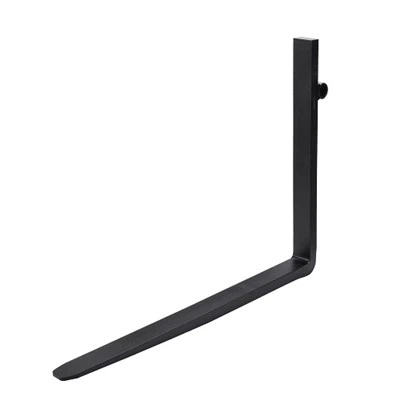
In the realm of material handling and construction equipment, forks play a crucial role. Two common types of forks are pin type forks and telescopic forks. As a supplier of Pin Type Forks, I have witnessed firsthand the distinct features and applications of these two types of forks. In this blog, I will delve into the differences between pin type forks and telescopic forks to help you make an informed decision when choosing the right equipment for your needs.
Design and Structure
Pin type forks are characterized by their simple and robust design. They are typically attached to the equipment using pins, which provide a secure and stable connection. The forks themselves are usually made of high - strength steel, designed to withstand heavy loads. Pin type forks come in various lengths and widths, allowing for different load capacities and applications. For example, in a warehouse setting, shorter and wider pin type forks might be used to handle pallets, while longer and narrower ones could be employed for more specialized tasks like moving long and narrow objects.
On the other hand, telescopic forks have a more complex design. They consist of multiple sections that can slide in and out, allowing for adjustable reach. This telescoping feature is achieved through a hydraulic or mechanical mechanism. The ability to extend and retract the forks gives telescopic forks a significant advantage in terms of flexibility. For instance, in a large - scale logistics center, telescopic forks can reach into deep storage racks to retrieve or place items, which is not easily achievable with pin type forks.
Functionality and Applications
Pin type forks are well - suited for a wide range of applications where a fixed fork length is sufficient. They are commonly used in forklifts, backhoes, and other material - handling equipment. Pallet Forks for Backhoe are a prime example of pin type forks. They are ideal for moving pallets of various sizes, whether in a warehouse, a construction site, or a manufacturing plant. Pin type forks are also relatively easy to install and remove, which makes them convenient for operators who need to switch between different attachments quickly.
Telescopic forks, however, shine in applications that require variable reach. In industries such as warehousing, distribution, and shipping, telescopic forks can significantly improve efficiency. They can access items in high - density storage systems, such as automated storage and retrieval systems (AS/RS). Additionally, in outdoor applications like loading and unloading trucks, telescopic forks can reach into the truck bed more easily, reducing the need for manual handling and increasing productivity. For example, Bucket Pallet Forks with telescopic features can be used to handle different types of loads in a more versatile way.
Load Capacity and Stability
Pin type forks generally have a high load - carrying capacity. Their solid construction and direct attachment to the equipment ensure that they can handle heavy loads without significant deflection. The load capacity of pin type forks is often determined by the size and thickness of the fork blades, as well as the strength of the pin connection. In most cases, pin type forks are designed to handle loads ranging from a few hundred kilograms to several tons, depending on the specific model.
Telescopic forks also have a considerable load - carrying capacity, but their load capacity can vary depending on the extended length. When the forks are fully extended, the load capacity may be reduced due to the increased leverage and potential for deflection. However, modern telescopic fork designs are engineered to minimize this effect. Manufacturers use advanced materials and engineering techniques to ensure that telescopic forks can maintain a reasonable load capacity even at maximum extension.
Cost and Maintenance
In terms of cost, pin type forks are generally more affordable than telescopic forks. Their simpler design and manufacturing process result in lower production costs, which are passed on to the customers. This makes pin type forks a cost - effective option for small and medium - sized businesses that have relatively simple material - handling needs.


Maintenance of pin type forks is also relatively straightforward. Regular inspections of the pins, fork blades, and the attachment points are usually sufficient to ensure safe and reliable operation. If any parts are worn or damaged, they can be easily replaced.
Telescopic forks, on the other hand, are more expensive due to their complex design and the use of advanced technology. The hydraulic or mechanical components require more frequent maintenance to ensure proper functioning. This includes checking the hydraulic fluid levels, inspecting the telescoping mechanisms for wear and tear, and ensuring that the seals are in good condition. However, the increased cost and maintenance requirements are often justified by the enhanced functionality and productivity that telescopic forks offer.
Conclusion
In summary, the main differences between pin type forks and telescopic forks lie in their design, functionality, load capacity, cost, and maintenance. Pin type forks are simple, cost - effective, and suitable for applications where a fixed fork length is sufficient. They are widely used in various industries for handling pallets and other common loads. Telescopic forks, on the other hand, offer greater flexibility and reach, making them ideal for applications that require variable reach, such as accessing deep storage racks or handling loads in large - scale logistics operations.
If you are in the market for high - quality Pin Type Forks, we are here to assist you. Our pin type forks are designed and manufactured to the highest standards, ensuring durability and reliability. Whether you need forks for a forklift, a backhoe, or other equipment, we have the right solution for you. Contact us today to discuss your specific requirements and start a procurement negotiation. We look forward to working with you to meet your material - handling needs.
References
- Material Handling Equipment Handbook, 3rd Edition
- Industrial Forklift Operations Manual
- Construction Equipment Maintenance Guide